Showing posts with label African American Issues. Show all posts

Friday, November 13, 2009

THUNDER COLLINS, HIS TALENT IS HIS CALL


American essayist, philosopher, and poet Ralph Waldo Emerson once said "Each man has his own vocation; his talent is his call. There is one direction in which all space is open to him."

The substance of this quote can apply to nearly any aspect of life and in any profession. Doctors, lawyers, engineers, barbers, sports whatever the profession, an individual realizes they have some degree of talent and then work to develop their skill set. The athlete who works hard becomes a world famous player and the best in his sport. The doctor who works hard becomes a world renowned surgeon.

Lebron James, Michael Jordan, Johnny Cochran.............. what do they all have in common? All had talent and developed it to be successful. Far more important than developing their talent is the fact that they were fortunate enough to not get in their own way while developing that talent.


What do I mean by this? Far too many times we have witnessed people who have talents one can only dream of; yet they are unable to get out of the way to allow the talent to blossom.

Thunder Collins was a University of Nebraska running back. As a  high school senior he rushed for over 1,110 yards. He was a Junior College All American and was recruited by several large universities.

Today, Thunder Collins is a convicted killer sentenced to life in prison with an additional 110 years for other counts. Thunder Collins provides a prime example of how we get in the way of our talents and close the space that Emerson spoke of.

Thunder Collins (Univ of Nebraska), Lawrence Phillips (Univ of Nebraska), Cecil Collins (LSU), and Maurice Clarett (Ohio State) are all bad exmaples of young black men with endless potential and are all currently incarcerated. Why is this?

If a man’s talent is his calling, why are their life changing obstacles placed before him that prevent him from reaching his calling?


Wednesday, November 4, 2009

Blackboard Experience: It Takes a Village to Raise a Child


Some of the stories that I share are for inspiration, overall uplifting and celebration of things that people may do in the black community that may get overlooked. I try my best to bring light to these great contributions or achievements from people. However, some of my stories comes from absolute outrage or an experience that really compels me to share what I see, think and thought at the time that this was going on.


ATLANTA WEEKEND OCT. 30 – NOV. 1

On Saturday, Oct. 31, which was Halloween, I went to a Halloween party. This party was nothing special. It was just normal everyday costume party. Nothing ridiculous or out of the ordinary happened. It was my experience stopping at the gas station that struck a nerve in me. I stopped at the gas station to get a pack of gum. As I was walking into the gas station, I noticed there were about 5 to 6 black kids hanging out around and in the convenience store.


 Now, to some people, this may not be a big deal but to me, it was an extremely big deal. This black male who was between 17- 21 years old by my guess asked me if I smoked weed. Initially, I thought that he was looking for weed and then I realized that he was trying to sell me weed. The first time he asked me I did not turn around because I did not think he was talking to me. Then again, when I was leaving out, he asked me again. I answered short and abruptly,

“Nah dog.”

As I was walking out I noticed two girls were part of the five people hanging around. I was not able to determine if the cashier was black or some sort of foreigner. However, I did notice that the glass between him and I was at least 4 inches thick.

 These are some questions I begin to ask myself:

WHY

Why is this kid in a convenience store owned by a foreigner hanging out in the store and not buying anything and trying to sell me weed? It is 9:00 pm or a Friday night. Isn’t there a School Halloween Dance, football or basketball game going on? Isn’t there a girl you could take to the movies? Couldn’t you be at a job? Isn’t there something else you could be doing with your time? Also, what were the girls doing there? Are they trying to hang around the guy that is selling weed? Is that cool?

HOW

How did this become something to do for this kid? What motivates him to hang at a store away from home? Is he hanging away from home because his parents will be upset at home if they caught him selling in the neighborhood? Is his parents even around? How can’t this kid be doing 100 other things?

WHEN

When did this become acceptable? When did people who own stores allow people to loiter in and around their property selling weed? Doesn’t that affect their business? Are they scared to tell this kid something because he may cause harm to them?

WHAT

What should I have down? Should I have tried to talk to him and ask him his situation and offer him help? Would he have looked at me driving a Toyota Camry and said, “What the hell will I listen to him for?” Would he have gotten upset with me if I tried to interfere?Well, I don’t know because I walked out without a word or even a look. I went to my party and although this was on my mind, I still had fun and followed my normal routine.

Here are my questions to you:

Should I even be complaining about this considering that I did or said nothing?
Are we responsible for this disturbing behavior?
Can this pattern of behavior be stopped and if so, how long will it take?

Lastly, the collective thoughts of people who may think about these things are extremely important to me. If you have any comments or concerns or anything on this matter, please comment because it takes a village to raise a child.

"It takes a village to raise a child" originated from the Nigerian Igbo culture and proverb "Ora na azu nwa" which means it takes the community/village to raise a child. The Igbo's also name their children "Nwa ora" which means child of the community. It has been in existence in Africa for centuries.


Thanks,
Dario Mobley

Tuesday, October 20, 2009

Blackboard Feature: Steve Perry - 100% Go To College


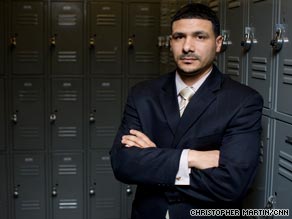
HARTFORD, Connecticut (CNN) -- Principal Steve Perry doesn't believe in cursory inspections. For him, every single detail matters. T's are always crossed, I's are always dotted. Shirts are always buttoned and tucked in.

During his daily morning hallway inspections, he reprimands a student not wearing the Capital Prep school approved sweatshirt with a "That's not our gray." He then quickly peers into another classroom to witness a student acting up. "Don't do it! Don't do it! Don't do it!" he warns sternly. The student retorts "Why not?" Perry knowingly looks at him and simply says, "You're the upperclassman" and with that, the student sheepishly walks away.

It's all part of the daily routine of tough love and high expectations at Capital Preparatory Magnet School in downtown Hartford, Connecticut. It's a public magnet school, with a college prep school attitude. As Perry says, "If you don't want to go to college, don't go to Capital Prep. Go somewhere else."

Perry's demanding approach has yielded big results. The school of just under 300 sixth- through 12th-grade students boasts a near 0 percent dropout rate. That's a stunning achievement considering Hartford is one of the lowest performing districts in Connecticut, a state with one of the largest achievement gaps between black and white students in the nation. According to the Connecticut Coalition for Achievement NOW, an educational advocacy group, black students in Connecticut are, on average, three grade levels behind their white peers.

Capital Prep, a year-round school that is more than 80 percent black and Latino, can boast of sending every graduating member of its senior class on to a four-year college. In the four years since Perry founded the school, he has sent 80 students on to college. See how Capital Prep is defying the odds »

Perry founded the school with the specific purpose of creating a school that would serve students with backgrounds similar to his. Born to a teenage mother, Perry grew up impoverished in a public housing project just outside Hartford. He recalls, "I had to be a principal at some point, or a prisoner, because I spent more time in the principal's office than the principal."

But it was Perry's fourth-grade teacher, Mr. Kensel, who saw the potential in Perry and set him straight. Perry knew he wanted to do the same for others.

"We decided we were going to open a school. We were going to serve mainly black and Latino children, but the only color I was looking at was the color of success," says Perry.

Perry has achieved that by holding staff and students to the highest expectations.

Breonna Arnum, 17, a senior at Capital Prep, believes it works.

"It makes a difference because everybody has the same goals as you. So it's not like anyone is there to pull you back. Everyone is going forward," Arnum says.

Her mother, Waynette Arnum, agrees. She believes it's a particular boon for students of color to be immersed in an environment with high demands.

"When you're in a school system and people look like you, and they're just as bright as you are, and they're kicking those As out and those 96s and 97s like you, you also know that you're surrounded by people just like yourself who are achievers," says Waynette Arnum. "And it's not an anomaly; it's not something that's rare."

She believes that seeing success is imperative, because black children need role models who look like them. Sound off: How can we keep our kids in school?

"For students of color, for black students, first of all, when you look at who your role models are, when you look at people that look like you, it tells us that we can do things," says Waynette Arnum.

In addition, she says black children are too often overlooked.

"I think that students of color are automatically stereotyped sometimes when they go into school systems that are predominantly white," says Waynette Arnum. "The stereotype that there's no father in the home, that the parents don't care; we have a plethora of stereotypes -- that the kids have behavioral problems, that the boys should all be put on Ritalin or something of that sort. Yes, these are definitely issues."

These are issues all black parents must face, says Angela Burt-Murray, editor-in-chief of Essence Magazine. Burt-Murray is the mother of two black boys and she and her husband are not only parents, but also advocates for their children.

"It starts with formulating that relationship with the teacher, letting the teacher know that you are an involved and concerned parent," says Burt-Murray.

Waynette Arnum agrees that parents have to speak up. That's exactly what she did.

"I definitely had to sit there and let the teachers know, let the school system know, let the parents know and let my daughter know that yes, I am an advocate," says Arnum. "And, all students deserve to learn equally."

Arnum believes Breonna was overlooked in elementary school, simply because of the color of her skin. It prompted her to not only stand up for her own daughter, but also to join a Students of Color Committee in the town of Manchester, Connecticut.

"There were definitely issues that were particular to my daughter that later I knew would be particular to all students of color. So that's how come I had to be involved," recalls Arnum.

Arnum believes if she hadn't stood up for her daughter, things could have turned out differently.

"I feel as though if I hadn't started off the way I had, Breonna still would have slipped though the cracks, even though we push her at home," Arnum says.

Perry, the dedicated principal, agrees that black children can frequently be the victims of stereotypes. It's the reason he pushed so hard to create an environment where everyone was held to the same expectations.

"In our school, it's college prep for everybody; it doesn't matter if you're black or white. They can see that it's OK for them to be smart and black," says Perry.

http://www.cnn.com/2009/LIVING/07/22/bia.education.success/index.html